Buyer Resource
A brochure, price list or projected yield example is not enough to understand a branded or managed residence ownership model.
Before relying on the commercial presentation, buyers should request the documents that define ownership, fees, use rights, rental arrangements, operator control, exit rules and documentation quality.
Bondomo helps buyers prepare document requests and questions before professional review. It does not provide legal, tax, investment, brokerage or purchase advice.
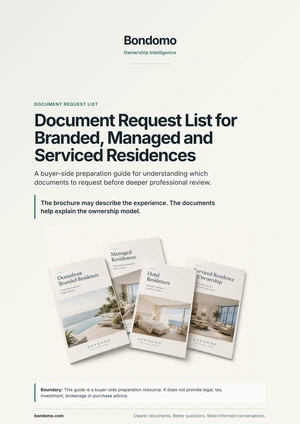
PDF Guide
Document Request List
A practical working guide for requesting the documents that define ownership, fees, use, rental arrangements, operator control and exit.
PDF · 18 pages · 1.7 MB · Updated July 2026
Preparation resource only — not a legal review, project approval or purchase recommendation.
Short answer
Buyers should request more than sales material. A useful document set normally includes ownership documents, a full fee schedule, service charge information, FF&E reserve details, management or operator agreements, owner use rules, rental pool terms, house rules, resale rules and transfer provisions.
The objective is not to approve or reject a project. It is to distinguish what is visible, what is partly visible, what remains unclear and which questions belong with qualified professional advisers.
When does this question arise?
This question usually arises when a buyer has moved beyond general interest and is reviewing a specific branded, managed, hotel or serviced residence opportunity.
- A brochure, price list or reservation pack has been provided.
- The offer includes a rental pool, managed letting programme or projected yield example.
- Service charges, management fees or FF&E reserves are mentioned but not fully explained.
- A reservation is being considered before the full ownership documents are available.
- The buyer wants to prepare focused questions for the seller, operator or professional advisers.
Document Request Matrix
The matrix below shows the main review areas and the documents or information buyers should usually request before relying on headline pricing, marketing claims or yield examples.
| Review area | Documents or information | Buyer question |
|---|---|---|
| Ownership | Purchase agreement, ownership summary, title or tenure information and reservation terms | What exactly am I buying, and which document defines my rights? |
| Fees | Fee schedule, service charge budget, management fees, FF&E reserve, reserve fund, indexation and transfer fees | Which fees are fixed, estimated, indexed or discretionary? |
| Operator | Management agreement, operator agreement, service standards, reporting obligations and replacement rules | Who controls services, standards, reporting and renovations? |
| Use | Owner use rules, house rules, blackout dates, guest rules, reservation procedures and letting requirements | When can I use the residence, and what restrictions apply? |
| Rental | Rental pool agreement, rental management terms, revenue split, deductions, reporting and projection assumptions | Which assumptions and deductions sit behind the rental example? |
| Exit | Resale rules, transfer fees, rights of first refusal, consent provisions and mandatory resale channels | Which approvals, fees or process limits apply to resale? |
| Documentation quality | Document inventory, disclosure pack, version dates, missing-document list and written responses | Which documents are available, missing or still unclear? |
The matrix is a preparation framework. Transaction- and jurisdiction-specific requirements should be confirmed with qualified professional advisers.
Typical missing documents
Buyers often receive polished marketing material before receiving the documents that define the ownership model. Common missing or incomplete items include:
- full fee schedule
- service charge budget
- FF&E reserve details
- management agreement
- rental pool agreement
- owner use rules
- house rules
- resale rules
- transfer fees
- operator consent provisions
A missing document is not automatically a problem. It is an area to clarify before relying on the offer as a complete picture.
Questions to ask
Questions for the seller
- Which documents define the ownership structure and buyer obligations?
- Can you provide the complete fee schedule and reserve information?
- Which fees are estimated and which are contractually defined?
- Which documents explain owner use, guest use and house rules?
- What resale, consent and transfer rules apply?
- Which documents should be reviewed before reservation?
Questions for the operator
- Which services and standards are controlled by the operator?
- How are fees and reserve contributions calculated or updated?
- What rental reporting will owners receive?
- Is rental participation optional or mandatory?
- How are FF&E and replacement decisions handled?
- What happens if the operator or brand changes?
Questions for your professional adviser
- Which documents define the buyer’s rights and restrictions?
- Are fee and reserve obligations clearly documented?
- Which clauses affect use, rental or resale?
- Are consent rights or mandatory resale channels relevant?
- Which matters require local legal, tax or regulatory review?
- Which brochure assumptions are not supported by the documents?
Read how Bondomo structures ownership questions before professional review
How to read the document set
A useful first review separates what is visible from what is still unclear.
| Status | Meaning | Buyer action |
|---|---|---|
| Visible | The information is clearly shown. | Check where it is documented and whether it is consistent. |
| Partly visible | The topic is mentioned but not fully explained. | Request the underlying document, schedule or clause. |
| Unclear | The information is missing, vague or inconsistent. | Request clarification before relying on the offer. |
| Not assessable | The available material is insufficient. | Request missing documents and involve advisers where relevant. |
| Professional review | The issue requires specialist review. | Prepare the question for the appropriate professional. |
These labels describe information visibility. They are not project ratings, legal conclusions or investment assessments.
What Bondomo can help with
Bondomo helps buyers identify relevant document categories, separate fee, use, rental, operator and exit questions, and turn unclear areas into questions for sellers, operators and professional advisers.
Bondomo helps buyers prepare document requests and questions. It does not provide legal, tax, investment or brokerage advice, approve projects, validate yields or make purchase recommendations.
Next step
Use the Buyer Checklist to connect document questions with fees, owner use, rental logic, operator control and exit.
FAQ
Is a brochure enough to review a branded or managed residence?
No. A brochure can explain the lifestyle, brand and commercial offer, but agreements, schedules and rules normally define the ownership model.
Which documents are usually most relevant?
Common starting documents include the purchase agreement, fee schedule, management agreement, owner use rules, rental pool agreement and resale provisions.
Should buyers request the rental agreement before relying on yield examples?
Yes. Rental examples should be read together with the programme terms, deductions, reporting basis, use limits and underlying assumptions.
Does Bondomo review contracts or approve documents?
No. Bondomo does not approve documents or provide legal review. It helps buyers prepare document requests and questions.
What should I do if documents are unavailable?
Ask what is available now, what will be provided later and which questions require professional review. Treat missing information as an area to clarify, not as an automatic conclusion about the project.
Bondomo helps buyers prepare. Your advisers help you decide.